
Objective
Most people buying a container canopy for the first time focus only on price. That one mistake leads to a string of other problems, wrong size, weak fabric, poor anchoring, no warranty. This guide walks you through the seven most common buying mistakes so you can skip the frustration, avoid wasted money, and get a canopy that actually does its job for years.
Key Takeaways
- Price should never be the first filter when shopping for container canopies for sale listings
- Buying the wrong size is one of the most common and most avoidable mistakes
- Cheap container canopy problems usually show up within the first season outdoors
- Fabric weight, wind rating, and frame material all determine real-world performance
- A shipping container canopy for sale with no spec sheet is a product worth skipping
- Container canopy buying mistakes almost always come from rushing the decision
Why So Many Container Canopy Purchases Go Wrong
Buying a container canopy looks straightforward from the outside. You find a listing, check the price, and place the order. Simple enough. But then the product arrives, and nothing quite fits right. The fabric feels thin, the frame wobbles. The first windstorm rips the whole thing loose.
This happens more often than most people talk about. And almost every time, it traces back to one of the same handful of mistakes made during the buying process , not after it.
The canopy market has expanded fast in recent years. There are more options available today than ever before. That is genuinely useful if you know how to evaluate what you are looking at. If you do not, more options just mean more ways to buy the wrong thing.
We at Sheltirx have worked with buyers across industries long enough to see these patterns clearly. The mistakes are predictable. Which also means they are completely avoidable. Here are the seven that cause the most damage.
Mistake 1: Choosing a Container Canopy for Sale Based Only on Price
Why the Cheapest Option Almost Always Creates More Problems in the End
This is the most common container canopy buying mistake by a wide margin. A buyer sees two products side by side. One is significantly cheaper. They go with the cheaper one and assume they got a good deal.
The problem with what they actually bought hasn't surfaced yet.
Cheap container canopy problems follow a predictable pattern. The fabric starts showing UV damage within months. Seams separate after the first heavy rain. Frame joints loosen or bend under wind load. Within a season or two, the whole thing needs to be replaced.
When you add up the cheap canopy plus the replacement, you have spent more than you would have on a quality product the first time. That is before factoring in any damage to the container or its contents caused by a failing canopy.
Price matters. But it should be the last filter you apply, not the first. Evaluate the spec sheet first. Compare GSM ratings, frame material, wind ratings, and warranty terms. Then look at the price within the group of products that actually meet your requirements.
Mistake 2: Not Measuring the Container Before Shopping
Wrong Dimensions Create Problems. No Amount of Adjustment Can Fix
It sounds too basic to get wrong. People get it wrong constantly.
Standard shipping containers come in set sizes , 10ft, 20ft, and 40ft lengths are the most common. But there are also high-cube containers that stand roughly a foot taller than standard units. There are open-top containers. There are half-height containers. Assuming your container is a standard size without measuring it first is a gamble that rarely pays off.
Before you look at a single shipping container canopy for sale listing, write down these three measurements:
- The exact length of your container
- The full width, including any side protrusions
- The height from the ground to the highest point of the roof
Then check those numbers against the compatibility specs listed on any canopy you consider. A canopy that does not match your container dimensions will not anchor correctly, will not cover what it needs to cover, and will perform poorly in wind because the connection points will be off.
Measure first. Shop second, every time.
Mistake 3: Ignoring the GSM Rating on the Fabric
This One Number Tells You More Than the Product Photos Ever Will
GSM stands for grams per square meter. It measures the density and thickness of the canopy fabric. Higher GSM means heavier, more durable fabric. Lower GSM means a thinner material that wears out faster under outdoor conditions.
Here is a simple reference:
For a container canopy that stays outside permanently, 400 GSM is the minimum that makes practical sense. Anything below that in a year-round outdoor setting is a cheap container canopy problem waiting to happen.
Many listings do not display the GSM rating. If a product page does not include that number, contact the seller and ask directly. If they cannot provide it, that tells you everything you need to know about the product quality.
Mistake 4: Overlooking How the Canopy Attaches to the Container
A Canopy Is Only as Secure as Its Connection Points
The frame and fabric get most of the attention. The anchoring system rarely does. That is a problem because how the canopy connects to the container determines how it performs when real weather arrives.
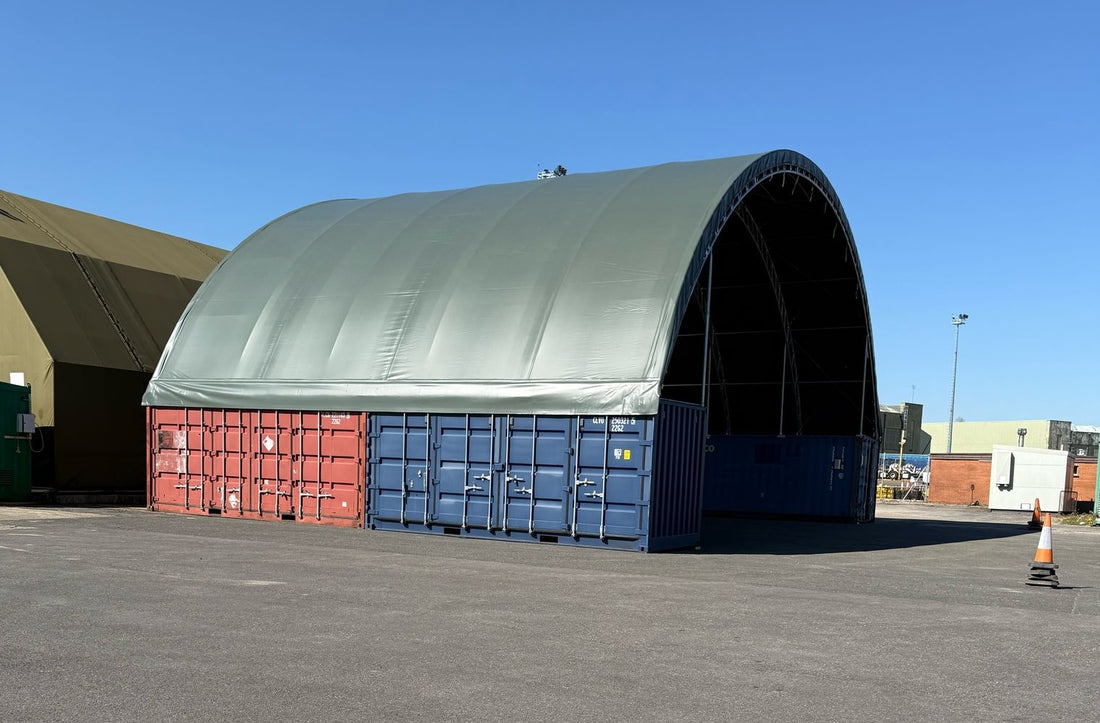
There are three main attachment approaches. Corner casting clamps lock into the standard holes at each corner of the container, creating the most structurally sound connection. Rail clamps grip along the top edge of the container wall and work well for over-roof style setups. Ground anchoring using auger stakes or concrete footings is used for freestanding canopy structures placed near containers.
What does not work , at least not reliably , is any system that uses bungee cords, lightweight straps, or basic rope as the primary connection. Those hold fine on calm days. They fail in conditions where you actually need the canopy to stay in place.
When reviewing any container canopy for sale listing, look for clear documentation of the anchoring method. If the listing does not describe how the canopy attaches, ask before you buy.
Mistake 5: Skipping the Wind and Snow Load Ratings
Weather Ratings Are Not Marketing Numbers , They Are Structural Facts
Many buyers view wind and snow load ratings as optional extras on the spec sheet. They are not optional. They are the difference between a canopy that stands through a storm and one that becomes a hazard.
Wind load indicates the maximum sustained wind speed the structure is engineered to withstand. For most outdoor applications, a minimum of 80 mph is a reasonable starting point. In coastal areas, open plains, or regions with frequent severe weather, you need 100 mph or higher.
Snow load is measured in pounds per square foot. Most quality industrial canopies handle 20 to 30 psf. If you are in a region that gets significant snowfall, confirm that the canopy you are considering is rated above your local code requirements, not just at them.
Skipping this check is one of the most serious container canopy-buying mistakes, because the consequences are not just financial. A canopy that fails under snow or wind load can damage the container, damage nearby property, and create genuine safety risks.
Mistake 6: Buying a Shipping Container Canopy for Sale With No Warranty
A Supplier Who Believes in Their Product Will Back It Up in Writing
Warranty terms are easy to overlook when you are focused on features and price. They should not be.
A quality container canopy should carry at a minimum a three-year warranty on both the fabric and the frame components. Better products come with five years or more. The warranty is not just a safety net. It is also a signal about how confident the manufacturer is in their own product.
Before placing any order, ask these specific questions:
- Does the warranty cover UV degradation of the fabric?
- Does it cover rust or corrosion on the frame?
- What does the claim process actually involve?
- Is the warranty transferable if the equipment changes hands?
If a supplier offers no warranty, a very short one, or cannot clearly explain what it covers, move on. There are enough reputable options in the container canopy market that you do not need to accept that kind of risk.
Mistake 7: Rushing the Decision Because of a Deadline or a Discount
Pressure-Based Buying Leads to the Wrong Product Almost Every Time
Job site deadlines, limited-time sale pricing, supply concerns , there are always reasons to feel like you need to decide fast. Most of those reasons are not as urgent as they feel in the moment. And almost none of them are worth buying the wrong product over.
A canopy that does not fit, does not perform, or fails within a season can lead to far more delays and replacement than taking an extra few days to make the right call would have.
Sheltirx builds fabric shelter systems for buyers who want to get it right the first time. That means taking the time to match specifications to actual site requirements, not just picking whatever ships fastest or is available right now.
When you feel pressure to decide quickly, slow down instead. Run through the checklist. Check the GSM. Confirm the dimensions. Verify the load ratings. Read the warranty. Then decide.
That process takes a few hours. The benefits last for years.
Conclusion: The Right Container Canopy Purchase Starts With the Right Questions
Every container canopy buying mistake on this list has the same root cause , not knowing what to ask before placing the order. The good news is that the right questions are not complicated. They are just specific.
What is the GSM rating? What are the exact compatible container sizes? What is the wind and snow load rating? How does it anchor to the container? What does the warranty cover?
Ask those questions of every shipping container canopy-for-sale listing you seriously consider. Any supplier worth buying from will answer all of them clearly and without hesitation, any supplier who cannot or will not is telling you something important about their product.
Avoid the mistakes in this guide, and you will end up with a container canopy that protects your assets, holds up in real weather, and pays for itself many times over throughout its service life.
"The right container canopy is not the one that ships fastest, it is the one that is still standing five years from now."
FAQs
What are the most common cheap container canopy problems to watch out for?
The most frequent issues with low-quality canopies include UV degradation of the fabric within the first season, seam separation after sustained rain exposure, frame joints bending or loosening under moderate wind, and anchoring systems that pull free in storms. These problems almost always trace back to low GSM fabric, uncoated frames, and inadequate connection hardware. Buying on price alone is what puts most buyers in this situation.
How do I know if a shipping container canopy for sale listing is worth trusting?
A trustworthy listing will include a full specification sheet showing the GSM rating, frame material, wind load rating, snow load rating, and exact container size compatibility. It will also clearly state warranty terms and provide an installation guide. If any of those elements are missing and the seller cannot provide them on request, treat that as a red flag.
What size container canopy do I need for a 40ft shipping container?
You need a canopy rated for a 40ft container length and at least 8ft width for a standard unit. If your container is a high-cube model, add at least one extra foot of height clearance to your requirements. If you want a side overhang for a covered working space, factor in the additional width you need on each side beyond the container footprint.
Is a higher GSM canopy always better?
Higher GSM fabric is more durable and better suited for demanding outdoor conditions, but it also weighs more. For light seasonal use in mild climates, a mid-range GSM may be perfectly adequate. For permanent outdoor setups in regions with strong sun, heavy rain, or snow, higher GSM can provide added durability. Match the GSM to your actual conditions rather than buying the highest available by default.
Can I use a container canopy in a high-wind coastal area?
Yes, but only if the canopy is specifically rated for the wind speeds common in your area. In coastal regions, look for canopies with a minimum wind rating of 100 mph and ideally 110 mph or higher. Confirm the anchoring system uses corner casting clamps or engineered ground anchors rather than strap-based systems. Always check local building codes for structural wind load requirements before purchasing.
Do container canopies require building permits?
This depends on your location, the canopy's size, and whether it is classified as a permanent or temporary structure. Smaller temporary canopies often fall below the permit threshold. Larger permanent installations frequently require a permit and may need to meet local building code standards for wind and snow loads. Always check with your local authority before installation to avoid compliance issues after the fact.